
BAC Water Amazon Testing — March 2026 | Only 2 of 11 Passed | Data Shared by Peptide Crafters

I want to be upfront about something: I don’t work directly with Peptide Crafters, they’re not listed on PeptidePrice.store, and there’s no affiliate code involved here. I had the chance to meet the owner recently and we both landed on the same page — more real data in the hands of researchers is always the right call, regardless of any commercial relationship.
They gave me permission to share early results from their latest round of Amazon BAC water testing. These COAs were just completed in March 2026 by Vanguard Laboratory (A2LA accredited, ISO 17025). This is round three of their ongoing testing — they’re planning at least two more rounds, so there will be more data coming.
Full COAs available here: https://drive.google.com/drive/folders/1eFMunYxcGjYhzPm8wwTpIGg32ZLOHQMj?usp=sharing
Most people in this space spend serious money on peptides. They research vendors, read COAs, chase purity numbers, and store everything correctly. Then they grab a $8 vial of bacteriostatic water off Amazon and reconstitute with it without a second thought.
That’s the variable nobody talks about — and this data makes a strong case that it should be the first thing you lock down, not an afterthought.
Why BAC Water Quality Actually Matters
Bacteriostatic water serves two critical functions: it reconstitutes your peptide, and it preserves it during storage. Two parameters determine whether it does that job correctly — pH and benzyl alcohol content.
pH affects peptide stability at the molecular level. Most peptides are stable in a mildly acidic environment (roughly 4.0–7.0 per USP standards). When pH climbs above 7.0 into alkaline territory, you create conditions that accelerate hydrolysis and degradation. High pH also destabilizes certain peptide bonds and can cause aggregation — which is exactly what you’re seeing when your vial goes cloudy or gels up after reconstitution. That cloudiness isn’t harmless particulate. In many cases it’s aggregated or partially degraded peptide. You’ve ruined your compound before the first dose.
Benzyl alcohol is the preservative. The USP standard range is 0.72%–1.08%. Too low and it loses bacteriostatic efficacy — meaning microbial growth becomes a real possibility in a multi-use vial. Too high and you introduce unnecessary preservative load. Either way, you’re outside spec.
The failure mode most researchers experience but don’t connect: they reconstitute a high-quality peptide with out-of-spec BAC water, the peptide aggregates or degrades faster than expected, and they blame the peptide. The BAC water was the variable the whole time.
The Data — 11 Amazon Samples Tested, March 2026
All testing performed by Vanguard Laboratory (A2LA accredited, ISO 17025). USP acceptable ranges: Benzyl Alcohol 0.72%–1.08% | pH 4.0–7.0
Parrox Reconstitution Solution — BA: 0.81% Pass | pH: 7.53 FAIL — FAIL
Lamda Water — BA: 0.87% Pass | pH: 5.1 Pass — PASS
HydraTide Labs — BA: 0.93% Pass | pH: 7.26 FAIL — FAIL
Awat Science — BA: 0.81% Pass | pH: 8.8 FAIL — FAIL
BioVitalis Solutions — BA: 0.83% Pass | pH: 6.92 Pass — PASS
JR Globals — BA: 0.64% FAIL | pH: 6.7 Pass — FAIL
Regenix Research — BA: 0.93% Pass | pH: 7.32 FAIL — FAIL
AaBaCa LLC — BA: 0.87% Pass | pH: 8.69 FAIL — FAIL
LivWell Research Labs — BA: 0.81% Pass | pH: 7.53 FAIL — FAIL
Quanta Nova Peptides — BA: 0.72% Pass | pH: 7.87 FAIL — FAIL
Reconstitution Solution (Lot TE202601) — BA: 0.61% FAIL | pH: 8.36 FAIL — FAIL
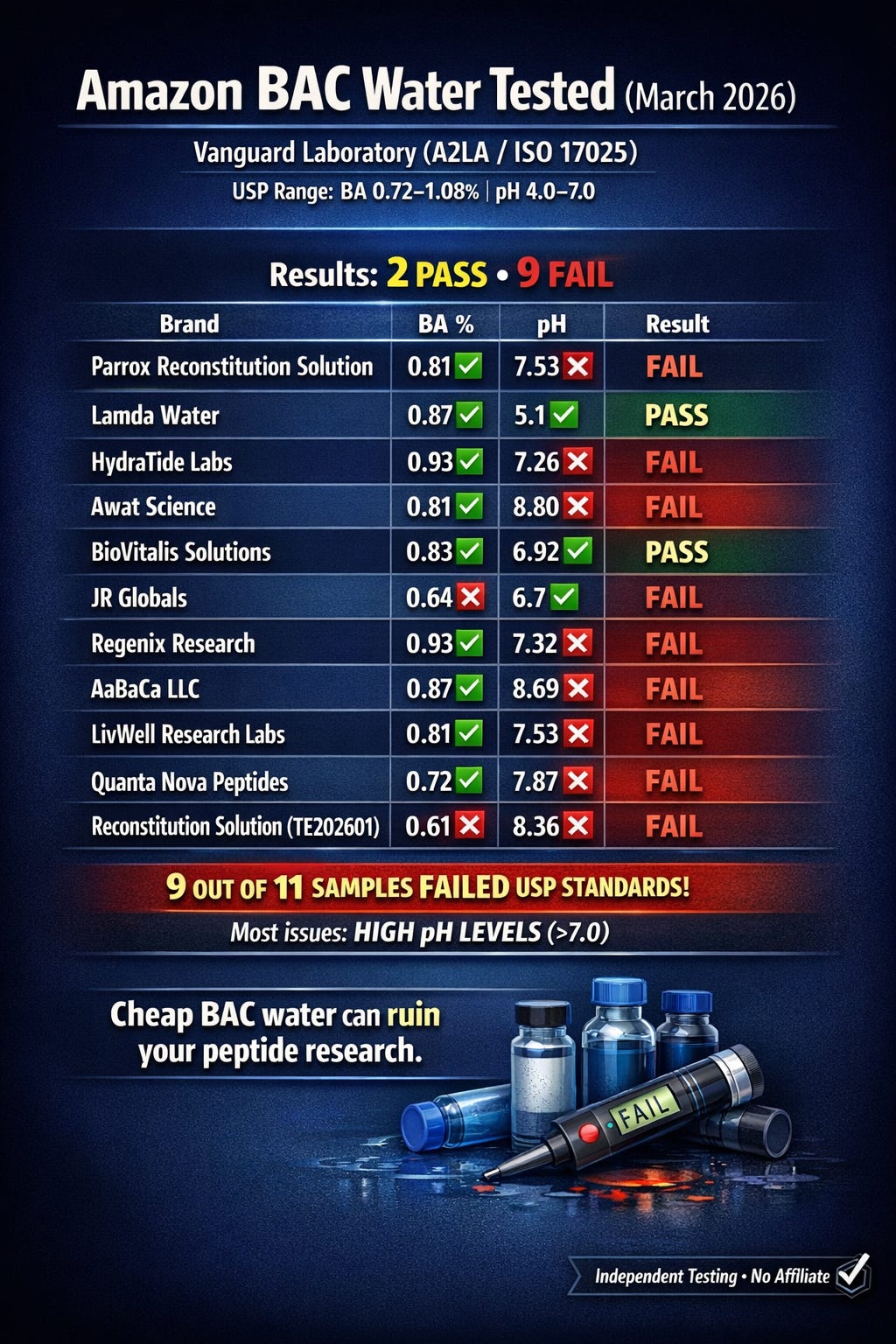
9 out of 11 samples failed. Only Lamda Water and BioVitalis Solutions passed both parameters.
The pH failures are what stand out. Seven samples came in above 7.5, with Awat Science hitting 8.8 and AaBaCa LLC at 8.69. Those aren’t borderline misses — those are significantly alkaline solutions being sold on Amazon and marketed for reconstituting sensitive research compounds. At a pH of 8.8 you are actively creating conditions for peptide degradation the moment you pull back the plunger.
The final sample (lot TE202601, labeled Reconstitution Solution) failed both tests — BA at 0.61% and pH at 8.36. If you’re using this to reconstitute and store a peptide you’re dealing with inadequate preservation and an alkaline environment simultaneously.
What This Means Practically
You can do everything else right and still introduce the one variable that quietly compromises your research. Out-of-spec BAC water doesn’t announce itself. Your peptide doesn’t turn a different color when it starts degrading. The aggregation may be subtle. The loss in potency happens gradually. You won’t necessarily know until your results don’t make sense or your vial clouds up.
Hospira BAC water has a long track record, known specs, and is what most legitimate research operations reach for by default. It’s not the only acceptable option, but it’s the standard for a reason. The cost difference between Hospira and a random Amazon listing is trivial compared to the value of the compounds you’re protecting.
This isn’t a sponsored post. There’s no code, no commission, no listing arrangement. Peptide Crafters runs their own operation independently and didn’t ask for any of this. I’m sharing it because the data is real, it’s relevant, and the community is better off knowing it exists.
Peptide Crafters plans to run at least two more rounds of this testing. I’ll share results here as they come in.
Big shoutout to the PC team for doing this work and allowing me to share it. More to come.
All COAs from this round available here: https://drive.google.com/drive/folders/1eFMunYxcGjYhzPm8wwTpIGg32ZLOHQMj?usp=sharing
Great info, Derek, after watching your interview with Magic, my question is What do people in Europe use to recon their peptides?
Looks to me like the PH is what matters most. What’s your take? 🤓
Is this supposed to be Lamda or Lambda? Because Lambda is the only one I find selling bac water and if it’s different, you should specify. If it’s misspelled on these “official” results, that brings the entire set of results into question. It’s even misspelled on the COA itself.