
Epithalon vs Epithalon Amidate vs N-Acetyl Epithalon Amidate: A Three-Way Breakdown Of A Peptide That Keeps Getting Reformulated

Read this first: Everything below is for research and educational purposes only. Nothing here is medical advice, and nothing here is a recommendation to use any of these compounds personally. All three are research peptides labeled for research use only, not for human consumption. If you’re considering anything for personal use, that’s a conversation for a qualified clinician — not a Substack post.
Why This Is Worth Untangling
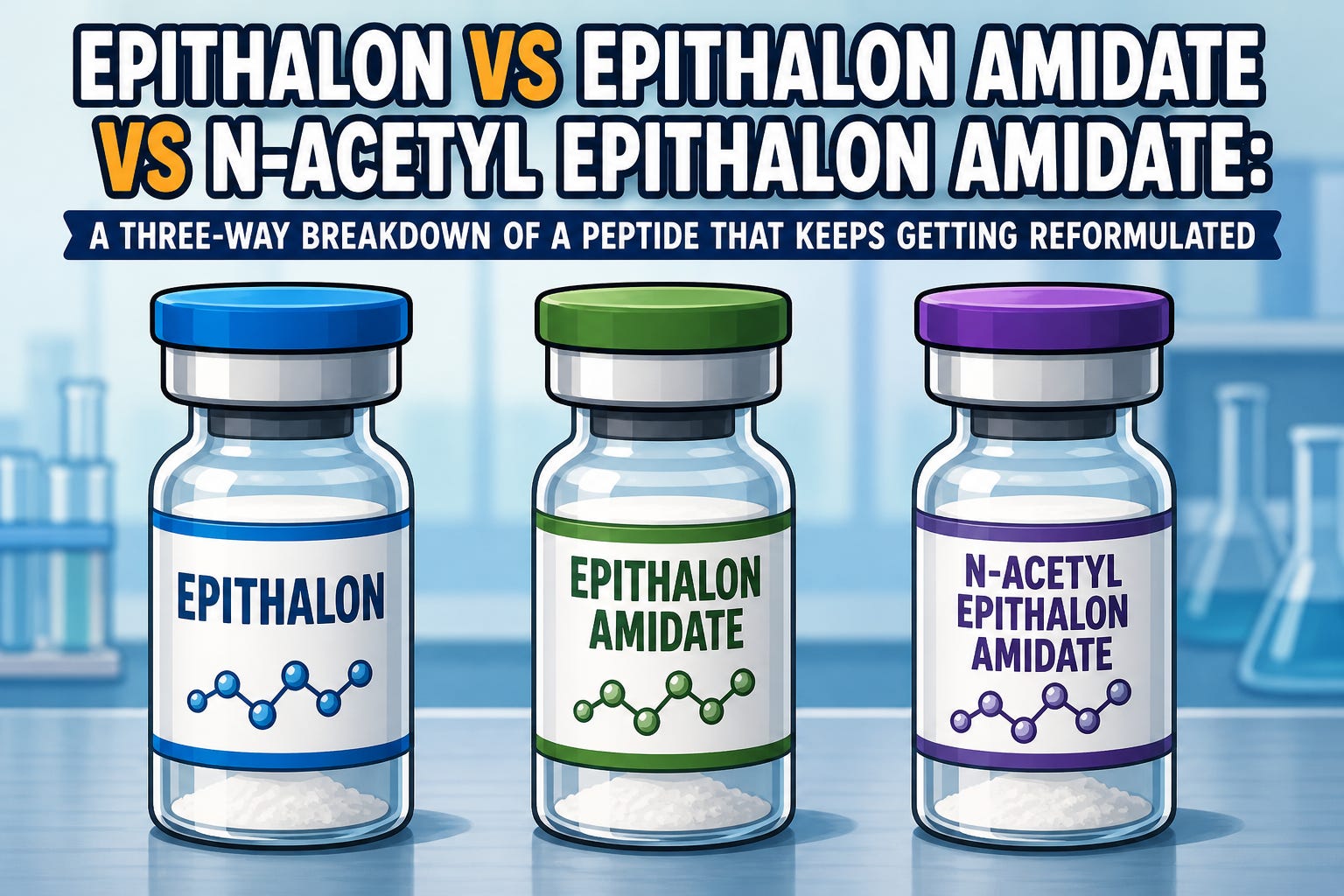
There are three versions of this peptide you’ll commonly see: Epithalon, Epithalon Amidate, and N-Acetyl Epithalon Amidate. Sometimes a fourth — straight “Epitalon” with one fewer letter, which is just an alternate spelling. Prices climb as you go up the chain. Each one is described as “more stable” or “more bioavailable” than the last. And the dosing protocols recommended for each one vary all over the map.
If you’ve been confused about which one is which, why they exist, and whether the “upgraded” versions are actually worth the price difference — this post is for you. The base mechanism is the same across all three. What changes is the chemistry at the ends of the peptide, and those changes affect how long the molecule survives in the body, how much of it actually gets where it’s going, and (theoretically) what dose you need to use.
The dosing debate is where this gets genuinely interesting. There are protocols floating around that recommend 10 mg of base epithalon and other protocols recommending 100 mcg of N-acetyl epithalon amidate. That’s a 100-fold difference in how much peptide researchers are using, all targeting the same downstream mechanism. Either everyone is wrong, or these compounds aren’t behaving the same way in the body — and the second answer is closer to correct.
Let’s break down what’s actually going on.
What The Base Peptide Is
Epithalon (also written as Epitalon, Epithalone, or AEDG) is a synthetic tetrapeptide with the amino acid sequence Ala-Glu-Asp-Gly. That’s it. Four amino acids in a specific order. Molecular formula C14H22N4O9, molecular weight around 390 Da.
It was first synthesized in the 1980s at the St. Petersburg Institute of Bioregulation and Gerontology under Vladimir Khavinson, based on the amino acid composition of a bovine pineal gland extract called epithalamin. Khavinson and his collaborators have published the bulk of the existing research on it across roughly 25-30 years of work — ranging from cell culture experiments through animal lifespan studies into human clinical observations.
The proposed master mechanism: epithalon binds to specific regions of DNA — preferentially methylated cytosine residues — and to histone proteins, which influences which genes are accessible for transcription. Through this epigenetic mechanism, it appears to upregulate expression of the catalytic subunit of telomerase (hTERT) in human somatic cells. Most adult human cells normally keep telomerase silenced, which is part of why telomeres shorten with each cell division. By reactivating partial telomerase expression, epithalon has been shown in fibroblast cultures to extend telomere length and push cells past the Hayflick limit by 10+ additional doublings.
Beyond the telomerase story, the literature describes effects on melatonin secretion, pineal function, antioxidant gene expression, immune function, and circadian regulation. A 2025 cell line study replicated the telomere-lengthening finding and proposed that epithalon may also activate ALT (Alternative Lengthening of Telomeres) pathways in addition to direct telomerase upregulation.
That mechanism is shared across all three versions. The amino acid sequence doesn’t change. What changes is what happens at the ends of the peptide chain.
The Problem All Peptides Face
Before we get into the modifications, you have to understand what kills peptides in the body.
Short peptides like epithalon are heavily targeted by enzymes called peptidases. Two specific enzyme classes do most of the damage:
Aminopeptidases — chew peptides from the N-terminus (the “front” amino group end)
Carboxypeptidases — chew peptides from the C-terminus (the “back” carboxyl group end)
Both are abundant in blood, in tissue, and in the GI tract. A naked four-amino-acid peptide hitting the bloodstream is essentially a meal for these enzymes. The half-life of base epithalon in circulation is short — minutes, not hours. That’s why subcutaneous injection of large doses (5-10 mg) is the standard delivery method in most epithalon protocols: you have to flood the system to get enough surviving peptide into target tissues before degradation wipes it out.
This is the problem the chemical modifications are designed to solve. Each modification protects one end of the peptide from one of those two enzyme classes.
Epithalon Amidate: C-Terminal Protection
Epithalon amidate is the same Ala-Glu-Asp-Gly sequence with a single chemical change: the carboxyl group (-COOH) at the C-terminus is replaced with an amide group (-CONH2). In peptide notation it’s written as AEDG-NH2.
What this does mechanically: amidation makes the C-terminus look less like a normal peptide ending and more like an internal peptide bond. Carboxypeptidases struggle to recognize and cleave it. Half of the peptide is now protected from one of the two main degradation routes.
Functional implications:
Increased resistance to carboxypeptidase degradation. The C-terminal end is no longer easy prey for that enzyme class.
Longer half-life in biological systems compared to base epithalon, though specific human pharmacokinetic data on the amidated form is limited.
Improved storage stability — amidated peptides tend to hold up better in solution, which matters for reconstituted peptide stored in a fridge over multiple weeks.
Modified physicochemical properties — the C-terminal amide changes the overall charge distribution of the molecule slightly, which can affect solubility and how it interacts with biological matrices.
What this does NOT do: protect the N-terminus. Aminopeptidases can still attack the front end of the peptide. So epithalon amidate is more stable than base epithalon, but it’s still vulnerable to about half of the relevant enzyme attack.
The mechanism of action — telomerase upregulation, epigenetic gene regulation, melatonin pathway effects — is unchanged. You’re researching with the same biologically active sequence, just with one end better defended.
N-Acetyl Epithalon Amidate: Double-Ended Protection
N-Acetyl Epithalon Amidate is what you get when you add a second modification on top of amidation: N-terminal acetylation. An acetyl group (Ac-) is added to the front amino group of the peptide. In peptide notation it’s written as Ac-AEDG-NH2.
What this does mechanically: the N-terminal amino group is the primary recognition site for aminopeptidases. Acetylation caps that site, making the peptide invisible (or much less visible) to that enzyme class.
Combined with the C-terminal amidation already in place, you now have:
N-terminus protected against aminopeptidases (acetyl cap)
C-terminus protected against carboxypeptidases (amide cap)
Both ends are defended. The peptide is now substantially more stable in circulation, more resistant to GI degradation, and theoretically capable of crossing biological barriers more efficiently — including, some sources argue, the blood-brain barrier (though direct human BBB penetration data on this specific compound is limited).
Functional implications cited in the research literature:
Significantly enhanced metabolic stability vs base epithalon
Longer biological half-life
Higher effective concentration reaching target tissues at any given research dose
Potential for lower-dose research to achieve the same downstream effect
Better preservation during storage and reconstitution
Again — the AEDG sequence in the middle is the biologically active part, and that hasn’t changed. The modifications are protective, not functional. You’re still working through the same telomerase / epigenetic / pineal mechanism. You’re just (theoretically) getting more of the peptide to where it’s supposed to act before it gets chewed up.
Why All Of This Matters: The Dosing Debate
This is where the practical confusion in the research community lives. Look across protocols and you’ll see numbers like:
Base epithalon: 5-10 mg per research dose, often daily for 10-20 day cycles, repeated 2-3 times per year. Some Russian clinical protocols use even higher daily totals.
Epithalon amidate: typically 1-3 mg per research dose, often run as 1-2 mg subcutaneously 3-5 days per week over 8-12 week extended cycles rather than the short-burst Russian model.
N-acetyl epithalon amidate: 100 mcg to 1 mg per research dose. The most commonly cited “Anela protocol” recommends 100-500 mcg/day for 10-20 days each month. Some researchers using more conservative dosing run 250 mcg per research dose; others have settled on 1 mg/day for 20-day cycles repeated 3-4 times per year as a middle-ground approach.
That’s a roughly 10x to 100x difference between the high end of base epithalon dosing and the low end of N-acetyl amidate dosing. The question every researcher in this space has to wrestle with: is that dose differential actually justified by the bioavailability differences, or is it marketing inertia from vendors trying to differentiate products?
The two base epithalon protocols you’ll see most often
Within base epithalon specifically, two patterns dominate: the 10 mg / 10 day cycle (often called the “Russian Protocol”) and the 5 mg / 20 day cycle. Both deliver the same total cumulative peptide per cycle (100 mg), and both trace back to the way the original Russian clinical work cycled the compound. The thinking behind them:
The 10 mg / 10 day protocol (Russian Protocol). Higher daily dose, shorter cycle. The logic is that base epithalon has a short half-life and gets degraded quickly, so flooding the system at a higher concentration each day pushes more surviving peptide into target tissues per research dose. Shorter cycle length also makes it easier to fit into a 2-3 cycles per year cadence with longer washout windows in between. This is the protocol most aligned with the Khavinson-group human studies that reported telomere length increases in elderly patients. Some practitioners use the full 10 mg as a single subcutaneous research dose at bedtime; others split it into AM and PM doses.
The 5 mg / 20 day protocol. Lower daily dose, longer cycle. The logic is that sustained exposure over a longer window may matter more than peak concentration — particularly for an epigenetic mechanism that operates through gene expression changes, which take time to manifest. Some practitioners also report the lower per-dose feels “smoother” subjectively (though that’s research subject anecdote, not measured data). This pattern more closely mirrors some of the longer Russian clinical observation periods.
The “Ukrainian Protocol” variant. Less commonly discussed but worth knowing about: 10 mg used only on days 1, 5, 9, 13, and 17 of a 17-day window. Total peptide per cycle is 50 mg — half the amount used in the Russian Protocol. The rationale is that pulsed dosing every 4 days may be sufficient to trigger the downstream regulatory cascades, since epithalon’s effects are thought to outlast the peptide’s actual plasma residence. If the bioregulator framework is correct (peptide triggers a cascade that persists after clearance), pulsed dosing should theoretically work — though it’s been studied less than the daily protocols.
Honest take on the base epithalon protocols: total peptide delivered varies between 50 mg (Ukrainian) and 100 mg (Russian) per cycle, and there’s no head-to-head clinical data directly comparing them. All three have been used in the Khavinson-group literature at various points. The choice between them is largely about research logistics and whether you prefer fewer-but-higher, more-but-lower, or pulsed exposures. Neither appears to be clearly superior based on the available evidence.
Now the modified-form protocols
This is where the dose math really diverges.
For epithalon amidate (AEDG-NH2). Most protocols sit in the 1-2 mg per research dose range. Some practitioners run 1-2 mg subcutaneously 3-5 days per week over an 8-12 week extended cycle — a markedly different cadence than the short-burst base epithalon model. Others apply the same Russian-style 10-20 day cycling but at the lower 1-2 mg dose. Total peptide per cycle ranges anywhere from 10-30 mg depending on which approach is used — substantially less than base epithalon protocols at the same cycle length.
For N-acetyl epithalon amidate (Ac-AEDG-NH2). The Anela protocol (100-500 mcg/day for 10-20 days monthly) is probably the most-cited reference point in researcher discussion. At the low end, that’s only 1 mg total per cycle. At the high end, it’s 10 mg. A separately reported approach uses 1 mg daily for 20-day cycles 3-4 times per year — totaling 20 mg per cycle, which is closer to the modified-form middle ground. Some researchers also experiment with intranasal research (250 mcg per spray) on the theory that the doubly-modified peptide’s increased stability and improved blood-brain barrier permeability make IN delivery more practical for this form than for base epithalon.
Cross-referenced against the base protocols, the math gets striking fast. If a researcher uses N-acetyl epithalon amidate at 200 mcg/day for 20 days, that’s 4 mg total per cycle — which is 25x less peptide than the Russian Protocol. At the very low end of the Anela protocol (100 mcg/day for 10 days = 1 mg per cycle), it’s 100x less. The vendor logic claims the modifications make up the difference. Whether that’s true at that magnitude of dose reduction is exactly the question that hasn’t been settled.
Where the dosing logic holds and where it breaks down
Honest answer on the modified-form dosing: nobody fully knows where the right dose is. Here’s what we can say with reasonable confidence and where the open questions are.
Where the dosing logic holds. The base mechanism is identical, so if the modified versions really do achieve substantially higher effective tissue concentrations per administered milligram, then a lower administered dose makes sense. The chemistry of N-terminal acetylation and C-terminal amidation is well-established across peptide pharmacology — these modifications reliably extend half-life and increase systemic exposure. That part isn’t speculative.
Where the dosing logic breaks down. The vast majority of the human and animal data we have on epithalon — the lifespan studies, the telomerase upregulation studies, the immune and cardiovascular outcomes — was conducted using base epithalon or epithalamin, at the higher doses. Almost none of the foundational efficacy literature was conducted using the amidated or doubly-modified versions. So when someone uses 200 mcg of N-acetyl amidate “because it’s 50x more bioavailable than base epithalon,” that’s an extrapolation, not a measurement. The actual pharmacokinetic comparisons in humans haven’t been done. Most of what’s reported about modified-form dosing comes from researcher self-experimentation and forum-style anecdata rather than published trials.
What that means in practice. The dose translation between these compounds is a working assumption, not a settled science. Researchers using the modified versions at low doses are doing so based on theoretical equivalence rather than head-to-head clinical data. That doesn’t mean it’s wrong — the chemistry is reasonable — but it does mean the “100x more potent” claims you see in promotional copy are essentially marketing language layered on top of plausible but unverified pharmacokinetic logic.
A practical heuristic: if you’re set on using a modified form, the more conservative middle-ground protocols (1 mg/day for 20 days for N-acetyl amidate, or 1-2 mg for amidate alone) sit closer to the dose math that would be theoretically equivalent to the base epithalon protocols if the modifications deliver something like 5-10x bioavailability improvement. The ultra-low microgram protocols (100-200 mcg/day) assume a much larger bioavailability multiplier that hasn’t been validated. Neither is clearly correct, but the middle-ground approach is harder to be wrong about.
Which One To Prioritize For Research
If I were laying out the use cases honestly:
Base epithalon (AEDG). The most researched form. If you want to mirror the protocols actually used in published studies, this is what was used. Higher doses, more frequent research use, more peptide consumed per cycle. Cheaper per milligram but you use more of it. The mechanism of action is documented across the largest body of evidence.
Epithalon amidate (AEDG-NH2). A reasonable middle ground. Better stability than base, less aggressive modification than the doubly-modified version. Less established dosing literature than base epithalon. Potentially useful for researchers who want some of the stability benefits without paying for the premium version.
N-acetyl epithalon amidate (Ac-AEDG-NH2). The most modified, theoretically the most stable, highest cost per milligram. Lower doses are typically used, which partly offsets the cost. The least direct human data of the three forms — most of the clinical and animal lifespan literature was not conducted with this specific compound. If you’re optimizing for theoretical bioavailability and minimizing research volume, this is the option. If you’re optimizing for “matches what was actually studied,” it’s not.
Important framing: none of the three has the kind of large-scale Western randomized controlled trial data that compounds like rapamycin have. The Khavinson group at the St. Petersburg Institute has produced most of the literature, with limited independent replication outside Russia. A 2025 independent study replicated some of the in vitro telomerase findings, which is a promising development, but the gap between Russian-led research and Western validation remains real.
What The Human And Animal Data Actually Shows
Quick summary across all forms (the modifications didn’t exist as separate test compounds in most of these — most of the older literature is on base epithalon or epithalamin):
Khavinson, Bondarev, Butyugov (2003). The foundational paper. Epithalon treatment of human fetal fibroblast cultures activated hTERT expression, increased telomerase activity, and extended cellular proliferative lifespan past the Hayflick limit by over 10 additional doublings.
Anisimov, Khavinson et al (2003, transgenic mice). Epithalon treatment in HER-2/neu transgenic mice reduced mammary tumor incidence and extended lifespan. This is one of the more counterintuitive findings — telomerase activation is often associated with cancer risk, but the model showed reduced tumor burden. The interpretation has been debated.
Khavinson et al (2000, Drosophila). Lifespan extension in fruit flies on pineal peptide preparation, contributing to the broader cross-species longevity claims.
Russian human clinical data. Multiple Khavinson-group studies report that epithalon and epithalamin significantly increased telomere lengths in blood cells of patients aged 60-65 and 75-80. They also report restoration of melatonin secretion in aged humans and monkeys, with effects on circadian rhythm.
Cardiovascular and metabolic. Russian clinical trials over 30 years have reported benefits in elderly patients with cardiovascular and metabolic disease, though the trial methodology and reporting standards don’t always match what Western research expects.
2025 independent replication (Al-dulaimi et al). Confirmed that epitalon increases telomere length in human cell lines through both telomerase upregulation and ALT activity. First independent replication of the core mechanism finding outside the Khavinson group. This matters because it addresses one of the longstanding criticisms of the epithalon literature.
The honest summary: the in vitro mechanism is increasingly well-supported and now has independent replication. The animal lifespan data is consistent across multiple species in the Khavinson group’s work. The human clinical data is real but methodologically uneven and would benefit enormously from large-scale Western randomized trials, which haven’t happened.
Side Effect And Safety Notes
Across the literature on all three forms, the safety profile is reported as favorable. No major adverse events have been documented in human clinical use at standard cycling doses. No tolerance or dependence. No significant lab abnormalities reported in long-term users.
Theoretical concerns worth understanding:
The biggest theoretical concern with any telomerase activator is the possibility of accelerating tumor growth in undiagnosed early-stage cancers. The Khavinson-group data in transgenic cancer-prone mice actually shows reduced tumor burden, which argues against this — but anyone with active malignancy or strong family history of cancer should be especially careful and work with appropriate medical oversight.
Effects on natural circadian rhythm and melatonin secretion mean dose timing matters. Most protocols recommend evening research dosing to align with the pineal pathway being targeted.
Cycling rather than continuous research use is the standard approach. 10-20 day cycles, repeated 2-3 times per year, is the most common pattern across protocols. Continuous daily research use is not how the underlying studies were designed.
Practical Takeaways
If you’re deciding between the three forms, here’s how I’d frame it:
The mechanism of action is identical across all three. You’re targeting telomerase upregulation and pineal pathway modulation regardless of which form you research with. The differences are in stability, half-life, and effective dose — not in what the peptide actually does.
The cost-per-effective-dose calculation is closer than the milligram price suggests. Base epithalon is cheaper per mg but you use more. N-acetyl amidate is more expensive per mg but you use less. The actual cost per cycle ends up roughly comparable across the three forms in most pricing.
The “100x more potent” claims are theoretical extrapolations, not measured pharmacokinetic equivalences. Treat them with appropriate skepticism. The chemistry is reasonable but the head-to-head human data doesn’t exist.
The most-researched form is base epithalon. If matching the actual study protocols matters to you, that’s the one most of the literature was built on.
The most theoretically optimized form is N-acetyl epithalon amidate. If reduced research volume, better storage stability, and theoretical bioavailability matter most, that’s the option. Just understand you’re working with extrapolated dosing.
Pick a vendor with third-party testing, COA freshness, and a track record. The peptide market for any of these three forms is full of wide quality variation, and reconstitution stability matters more for a peptide that’s already at the edge of stability than for something more robust.
Things Worth Researching Further
If you want to go deeper:
The 2025 Al-dulaimi independent replication paper — first non-Khavinson-group confirmation of the core telomerase mechanism. Read this if nothing else.
The 2020 Khavinson “AEDG Peptide Stimulates Gene Expression and Protein Synthesis during Neurogenesis: Possible Epigenetic Mechanism” paper in Molecules — best mechanistic deep dive on the epigenetic side.
Peptide chemistry fundamentals on N-terminal acetylation and C-terminal amidation — the same modifications are used across many other research peptides (Selank, Semax variants, others), so understanding the chemistry pays off broadly.
The Hayflick limit and telomere biology — useful framework for thinking about why telomerase activation matters at the cellular level and where the cancer-risk concerns come from.
The general pineal peptide literature beyond epithalon — there’s a related body of Khavinson-group work on bioregulators that’s worth understanding for context.
Final Thoughts
The three-way split between epithalon, epithalon amidate, and N-acetyl epithalon amidate is essentially a chemistry problem that has been turned into a product differentiation problem. The underlying biology is one peptide. The modifications are real and chemically meaningful, but the leap from “this version is more chemically stable” to “you need 1/50th the dose” involves more assumption than measurement.
For most researchers, the practical answer is: pick the form that matches your priorities. If you want to mirror the actual study protocols, base epithalon is what was studied. If you want better storage stability and lower research volume, the modified forms make sense. If you want to optimize for theoretical bioavailability, N-acetyl amidate is the most aggressive option.
What I wouldn’t do is pay a 5-10x premium for a modification claiming a 100x potency increase without understanding that the dose translation hasn’t actually been validated head-to-head in humans. The chemistry is sound. The marketing extrapolation is not.
The bigger picture: epithalon is one of the more interesting peptides in the longevity research space because it targets a fundamental mechanism (telomere maintenance) that very few other tools touch. The 2025 independent replication of the core mechanism is a real step forward for the credibility of the underlying biology, even if the question of which specific form to use is still being worked out.
This is for research and educational purposes only. Nothing in this post is medical advice or a recommendation to use any of these compounds personally. All three are research peptides labeled for research use only. If you’re interested in any of them for any non-research reason, that’s a conversation for a qualified medical professional.
Drop questions below — happy to go deeper on the chemistry of the modifications, the Khavinson literature, the dosing math, or how epithalon compares to other longevity peptides in our space.
References
Foundational telomerase/telomere research
Khavinson VK, Bondarev IE, Butyugov AA. Epithalon peptide induces telomerase activity and telomere elongation in human somatic cells. Bulletin of Experimental Biology and Medicine. 2003;135(6):590-592. doi:10.1023/a:1025493705728
Independent replication (2025)
Al-dulaimi S, Thomas R, Matta S, Roberts T. Epitalon increases telomere length in human cell lines through telomerase upregulation or ALT activity. 2025. doi:10.21203/rs.3.rs-7066545/v1
Comprehensive 2025 review
Overview of Epitalon — Highly Bioactive Pineal Tetrapeptide with Promising Properties. International Journal of Molecular Sciences. 2025;26(6):2691.
Animal lifespan research (HER-2/neu mice)
Anisimov VN, Khavinson VKh, et al. Effect of Epitalon on biomarkers of aging, life span and spontaneous tumor incidence in HER-2/neu transgenic mice. International Journal of Cancer. 2002.
Drosophila lifespan
Khavinson VK, Izmaylov DM, Obukhova LK, Malinin VV. Effect of epitalon on the lifespan increase in Drosophila melanogaster. Mechanisms of Ageing and Development. 2000.
Epigenetic mechanism / neurogenesis
Khavinson VK, et al. AEDG Peptide (Epitalon) Stimulates Gene Expression and Protein Synthesis during Neurogenesis: Possible Epigenetic Mechanism. Molecules. 2020;25(3):609. doi:10.3390/molecules25030609
DNA binding mechanism
Khavinson VK, Solovyov AY, Shataeva LK. Melting of DNA Double Strand after Binding to Geroprotective Tetrapeptide. Bulletin of Experimental Biology and Medicine. 2008.
Modified peptide chemistry (general)
Khavinson VK et al. Bull Exp Biol Med, 2003 135(4):429-432
Arutyunyan AV et al. Adv Gerontol, 2005 15(3):28-36
Anisimov VN et al. Neuro Endocrinol Lett, 2003 24(3-4):233-240
Combined intervention case report
Improving Biological Age, Telomere Length, and Cognition: A Case Report. Restorative Medicine. 2024.
So ideally all short form peptides would be best as N.....-Amidate?
I’ve had a problem with reconstitution of Epithalon 50mg in a 3ml vial from two separate vendors. Both times I used 3ml of Hospria BAC and both times liquid was very clear however there remained chunks that never dissolved, even after days at room temperature. Any suggestions??