

Another clip from the Janoshik interview. This one gets into how they verify that an Adamax sample is the full, complete molecule — and why the mass spec is the tool that settles it. I added some extra digging and context below.
First, what Adamax is. Adamax is a modified analog in the Semax family. The defining feature is an adamantane group attached to the peptide. That adamantane moiety is the whole point — it’s what distinguishes the complete Adamax molecule from a version that’s missing that piece.
So what actually is that group? Adamantane is a small, rigid carbon cage — ten carbon atoms locked into a symmetrical, diamond-like lattice (its name comes from the Greek word for diamond, because the carbon arrangement mirrors the structure of diamond). It’s bulky, fat-loving (lipophilic), and very stable. When you attach an adamantane group to a peptide, it tends to change how that peptide behaves — things like improving stability, slowing breakdown, and helping it cross lipid-rich barriers like cell membranes. In Adamax, that adamantane cage is the modification that defines it. Without it, you have a lighter molecule that isn’t the complete Adamax structure.
Here’s the key fact Peter laid out: there are two versions floating around.
The full, complete Adamax comes in at 1,032 Daltons. A second version sits at 984 Daltons, which is missing the adamantane moiety. In other words, the 984 version isn’t the full Adamax molecule — it’s lacking the exact group that completes the modification. The roughly 48-Dalton gap between the two is essentially the weight of that missing adamantane-related piece.
Now, how a mass spec catches this, in plain terms.
A mass spectrometer’s job is to measure the molecular mass of what’s in your sample. The basic process: the machine takes the molecules, gives them an electric charge (ionizes them), and then sends them through a field where they get sorted by their mass-to-charge ratio. Heavier and lighter molecules separate out, and a detector records each one. What you get on the other end is, as Peter put it, just a number — the molecular mass.
That’s why this works so cleanly for Adamax. The full molecule and the 984 version have different molecular masses (1,032 vs 984). Since the mass spec spits out a precise mass number, you don’t need anything fancy to tell them apart — you just look at the number. If it reads 1,032, it’s the complete molecule with all its modifications. If it reads 984, you’re looking at the version missing the adamantane group.
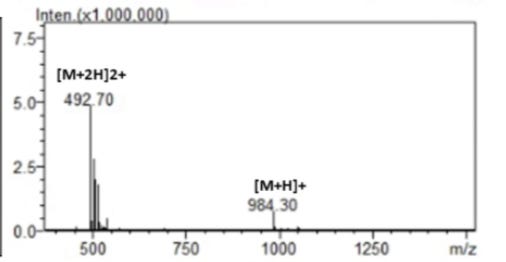
984 Da Detected Above
One more useful distinction from the clip: Adamax is not the same thing as N-acetyl Semax amidate. People sometimes lump these together, but Peter confirmed they’re different compounds with different masses. Each variation — amidated or non-amidated, with or without the adamantane group — carries its own distinct molecular mass, and the mass spec reads each one accordingly.
Why this matters for us as researchers: when a COA lists Adamax and the mass spec confirms 1,032 Daltons, that’s verification you’re getting the entire, intact molecule with all its modifications and not a lighter, incomplete variant. The mass number is the proof. It’s a good reminder that on compounds with closely related analogs, the identity test (mass spec) is doing just as much work as the purity number.
More clips coming as I keep editing.
Research use only. Not for human consumption.