
Topical Peptide Formats Explained — When to Use Raw Powder vs. Lyophilized

If you’ve ever browsed peptide vendors and seen the same compound listed as both a raw powder and a lyophilized vial, you’ve probably wondered — what’s the actual difference, and does it matter? The short answer is yes, it matters a lot. The format you want depends entirely on how it’s being used, and using the wrong one for the wrong application can affect stability, sterility, and overall results.
We’ll use GHK-Cu as our example throughout this post since it’s one of the most popular topical peptides in the space right now, but everything covered here applies broadly across topical peptide powders. Whether you’re formulating your own serums, working with a microneedling protocol, or simply trying to understand what you’re buying — this one is worth reading in full.
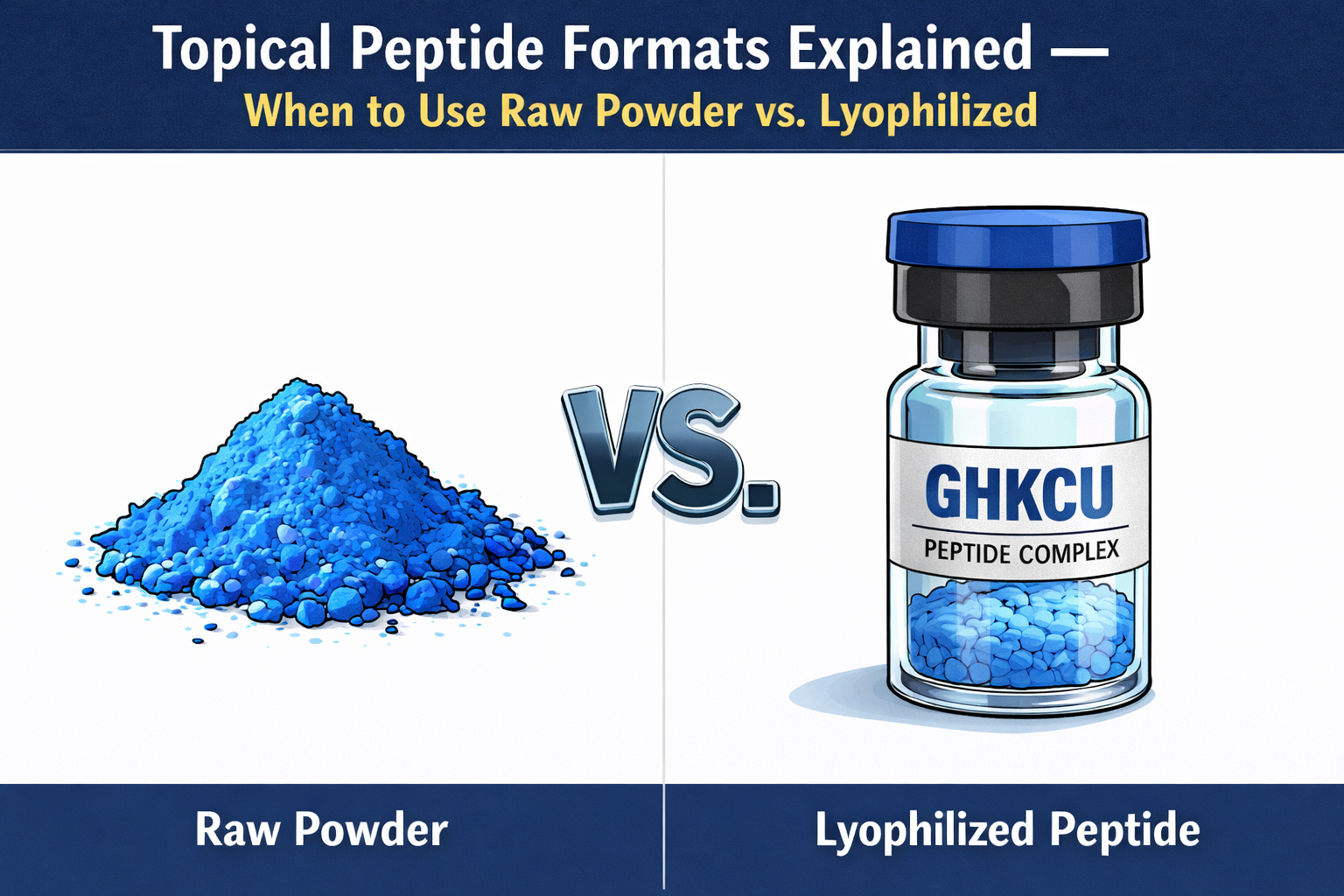
What Is Lyophilized (Freeze-Dried)?
Lyophilized peptides are freeze-dried into a cake or powder inside a sealed, sterile vial. The freeze-drying process removes moisture while preserving the peptide’s molecular structure, giving it excellent long-term stability without degradation. This format is designed to be reconstituted with a sterile solvent — typically bacteriostatic water — before use.
This is the standard format for peptides intended for subcutaneous research administration. The sterile vial, the sealed environment, and the reconstitution process are all specifically built around that use case. If you see a peptide in a sealed vial with a rubber stopper, you’re looking at a lyophilized product.
What Is Raw Powder?
Raw powder is a non-lyophilized, cosmetic or research grade powder meant to be dissolved directly into a formulation. It doesn’t come in a sterile sealed vial and isn’t designed for the same applications as lyophilized peptides.
For topical applications — serums, creams, microneedling, hair products — raw powder is almost always the right choice. Here’s a full breakdown of why and when.
When Raw Powder Makes More Sense
DIY Serums
Raw GHK-Cu powder dissolves cleanly into water-based serums — hyaluronic acid blends, copper peptide anti-aging formulations, hair growth serums, and more. One of the biggest advantages here is concentration control. You can dial in your exact percentage, typically anywhere from 0.05% to 0.5%, and dissolve it directly into distilled water or a cosmetic base without needing sterile conditions. This level of precision simply isn’t practical with lyophilized vials, which are designed for a different context entirely.
Creams and Moisturizers
Because GHK-Cu is water-soluble, it blends well into emulsions and custom cosmetic formulations. If you’re mixing it into a cream or lotion, add it during the cool-down phase of formulation — heat degrades peptides, and adding it too early in the process can compromise the compound before it ever reaches the skin. Aim for a pH range of around 5.0–7.0 for optimal stability and skin compatibility.
Microneedling (Topical)
For topical use during microneedling, raw powder dissolved in sterile water is the appropriate format. The peptide absorbs transdermally through the microchannels created by the needling process — it is being applied to the skin surface, not administered subcutaneously. Because of this, you don’t need a lyophilized vial designed for sterile reconstitution. That said, sterility still matters significantly here. Use sterile water, maintain clean technique throughout, and filter sterilize through a 0.22 micron filter if possible. Just because the route is topical doesn’t mean sterility can be treated casually.
When Lyophilized Makes More Sense
Lyophilized peptides are the right choice when subcutaneous research administration is intended. The sealed sterile vial, the long-term stability, and the reconstitution process are all specifically built around that use case. Freeze-dried peptides degrade significantly slower than hydrated solutions, and the lyophilized format is the industry standard for research peptides intended for subcutaneous administration.
If someone is working with a peptide in a topical context only, there is generally no need to pay the premium for a lyophilized vial — and in some cases, using that format for topical DIY work creates unnecessary complications without adding any benefit.
Stability — What You Need to Know
GHK-Cu and many topical peptides are sensitive to oxidation, extreme pH, and degradation in aqueous solution over time. Once dissolved into a formulation, refrigerate the solution and use it within a few weeks depending on storage conditions. Making smaller batches rather than large quantities that will sit is a good habit, and stabilizing agents are worth considering if you’re formulating for longer shelf life.
Raw powder stored dry and away from light and moisture will hold up significantly better than a prepared solution left sitting at room temperature.
One important note: if you’re adding a preservative to your formulation — such as Germall Plus — you won’t need to keep your serum or DIY blend refrigerated. A broad-spectrum preservative like Germall keeps microbial growth in check at room temperature, making it a practical option for anyone making larger batches or wanting extended shelf life without relying on cold storage. You can find Germall Plus here: https://amzn.to/4uhGVMj
Not All Raw Powder Is Equal
This point deserves its own section because it’s where a lot of people cut corners they shouldn’t.
If the intended application involves skin penetration, microneedling, or any research beyond basic surface-level cosmetic use — quality and purity are non-negotiable. Look for vendors who provide heavy metals testing, third-party purity COAs, and clear labeling distinguishing cosmetic grade from research grade. Cosmetic-grade and research-grade are not interchangeable, and the difference matters more the deeper the intended penetration.
Sourcing from a vendor with rigorous, transparent testing standards isn’t just a best practice — it’s the baseline.
Quick Reference
DIY Serum — Raw powder is the best choice. Lyophilized is not necessary. Moisturizer / Cream — Raw powder is the best choice. Microneedling (topical) — Raw powder is the appropriate format. Subcutaneous research administration — Lyophilized is the best choice. Long-term dry storage — Lyophilized is more stable.
Bottom Line
The format follows the function. Raw powder is built for topical formulations — serums, creams, hair products, and microneedling. Lyophilized is built for sterile reconstitution and subcutaneous research administration. Using the wrong format for the wrong application isn’t just inefficient — in some cases it creates unnecessary risk.
Know your format, know your source, and as always — low and slow.
Disclaimer: This post is for research and educational purposes only and does not constitute medical advice. Always consult a qualified healthcare professional before making any decisions.
-Derek Peptide Price
I do this personally. In fact, I had a bunch of that "Particle for Men" cream I stopped using after I discovered the GLOW protocols. I saved the empty GLOW cream jars, and pumped in the Particle cream, then blended with raw GHK-cu. If color is a good guide, my mix has a higher concentration than the vendor I normally use, but it lacks SNAP-8.
I use the professional GLOW for my face, and the homemade for my neck and stomach (scrambled eggs from weight loss).
Again, I see "heavy metals testing" being brought up. Has ANYONE EVER received a report of significant heavy metals after testing? IDK, it seems like testing your drinking water for Ebola. The chances are too low to be concerned. Speaking of drinking water, you probably get a TON of heavy metals from that anyway!
I have some lyophilized SNAP-8 and I planned to make it topical. I don't see how it makes sense to inject it. Can I mix it into a serum in this form?