
Why I Reconstitute Based on COA Net Peptide—Not the Label

This might be the most debated topic in peptide research circles.
You get a vial. The label says “10mg.” You check the COA and it shows 11.2mg net peptide content. Which number do you use when calculating your reconstitution?
I use the COA. Every time. And I’m going to explain why.
The Label Is Just a Target
Here’s the thing about that number printed on your vial: it’s a nominal amount. A target. An approximation.
The actual peptide content in any given vial varies. Your COA might show:
9.2mg in a “10mg” vial
10.4mg in a “10mg” vial
11.1mg in a “10mg” vial
24mg in a “20mg” vial
It’s rarely exactly what the label says. Sometimes it’s under. Often it’s over (vendors tend to overfill slightly as a buffer).
The COA tells you what’s actually in there. The label tells you what was supposed to be in there.
These are not the same thing.
The Counterargument (And Why I Still Disagree)
I’ve had this debate more times than I can count. Here’s the pushback I always get:
“But Derek, that COA is from ONE vial tested out of an entire batch. Your specific vial could be different. If the tested vial showed 24mg, that doesn’t mean YOUR vial has 24mg. You’re basing your math on a sample that might not represent what you actually have.”
This is a fair point. I talked about this in my post on conformity testing—even the best quality assurance involves statistical sampling, not exhaustive verification. We’re never going to have a COA for the exact vial in your hand.
But here’s my response: I’d rather base my calculations on real analytical data than an arbitrary number on a label.
The COA gives me actual measured data from that production batch. The label gives me... a round number someone decided to print.
One is information. The other is marketing.
What Most People Don’t Understand About Peptide Manufacturing
Here’s where it gets interesting, and where I think a lot of the confusion comes from.
Most people picture peptide manufacturing like this: someone weighs out powder, dumps it in a vial, caps it, done.
That’s not how it works.
Peptides are filled as a liquid solution, then lyophilized (freeze-dried) into powder.`3
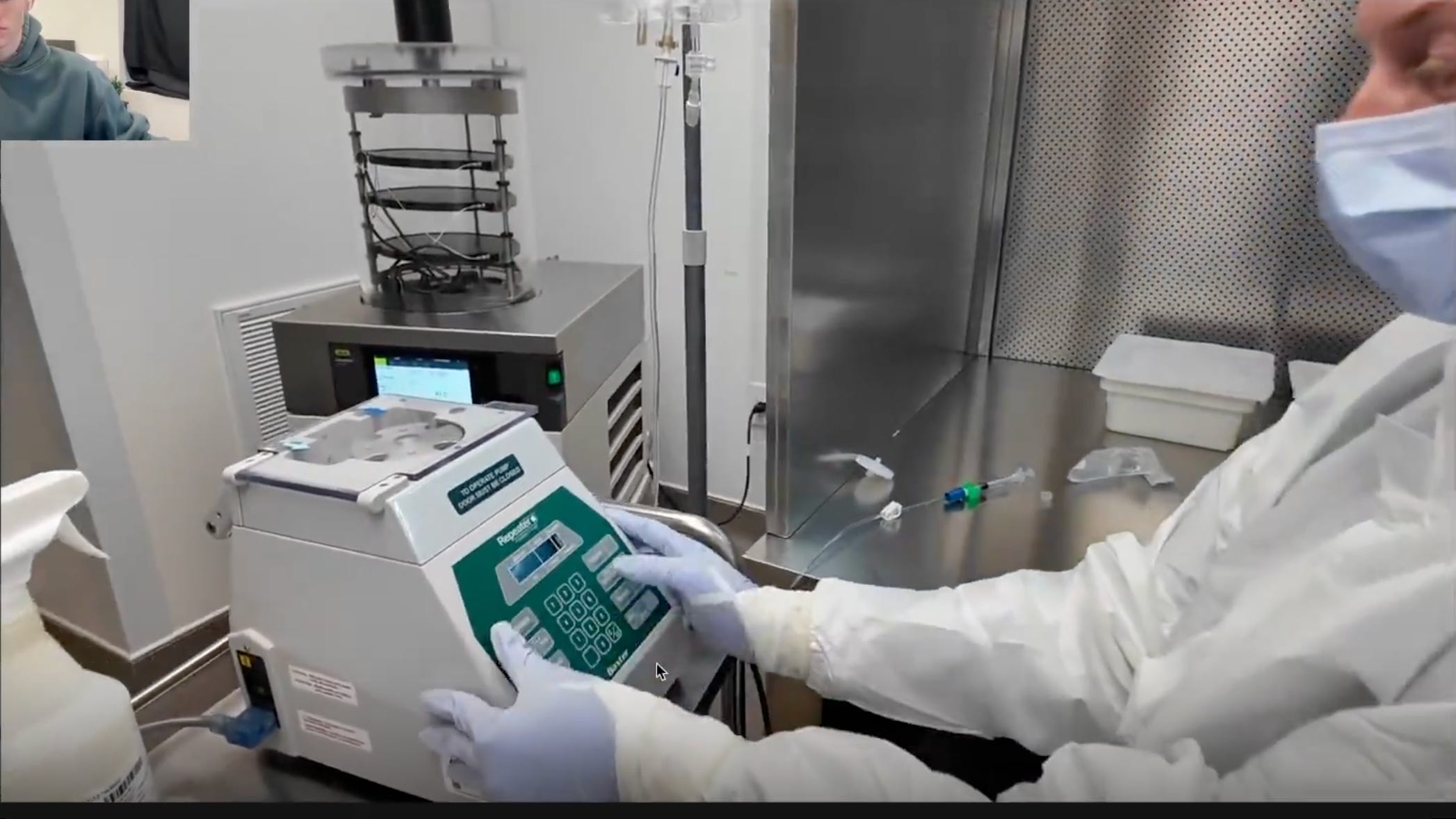
The process looks like this:
Peptide is dissolved into solution at a specific concentration (mg/mL)
That liquid solution is dispensed into vials using calibrated filling equipment
The vials go through lyophilization to remove the liquid, leaving behind the peptide powder
This is a critical detail. The filling equipment isn’t measuring powder—it’s dispensing precise volumes of liquid. And liquid filling can be calibrated to extremely tight tolerances.
Calibration In Action
If you want to see what this actually looks like, watch Sam’s lyophilization video from Valor Peptides. He walks through the entire filling process from calibration to capping.
One moment that stuck with me: the first two vials were scrapped because they didn’t fill at exactly 1mL.
Not “close enough.” Not “within acceptable range.” They were tossed because the calibration wasn’t dialed in yet.
That’s the level of precision good manufacturing labs operate at. The filler is calibrated to dispense exact volumes, which directly determines peptide content. When that calibration is locked in, every vial in the batch should fall within a tight +/- range of each other.
This isn’t random. It’s controlled.
So What Does This Mean For Your Vial?
Will your specific vial contain exactly what the COA says? Probably not down to the decimal point.
But will it be close? If the lab is doing their job properly—calibrating equipment, maintaining consistency, running conformity testing—yes. Your vial should be well within the acceptable variance of that tested sample.
And that variance around a measured value is a lot more reliable than just trusting “10mg” on a label that tells you nothing about what’s actually inside.
The Bottom Line
You have two choices when reconstituting:
Use the label (a round number, a target, an approximation)
Use the COA (actual analytical data from that production batch)
Neither is perfect. Neither guarantees your specific vial contains exactly that amount.
But one is based on real data. The other is based on an assumption.
I’ll take real data every time.
Want to see the actual filling and calibration process? Watch Sam break it down step by step:
Questions? Join the conversation at community.peptideprice.store
Can't an empty vial be zero out on scale to find exact weight?
I’m sorry please educate me where you’re finding the reconstitution under the coa?